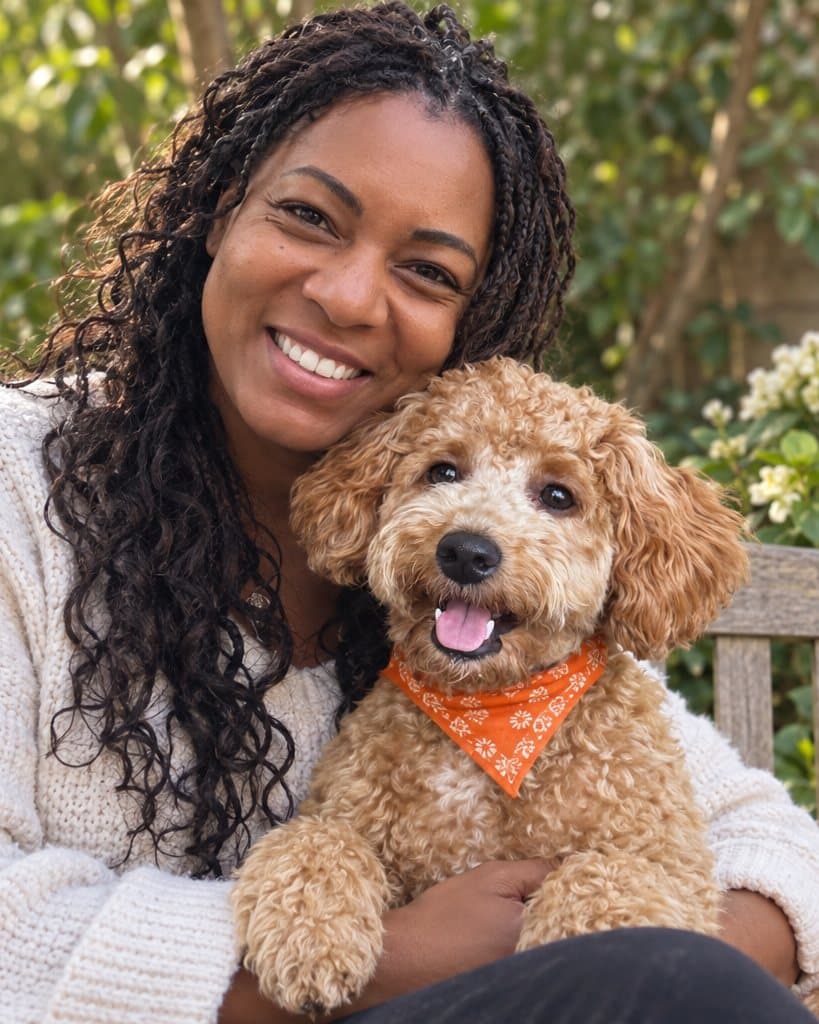
A dog mentor is not a therapy dog.
It is a trained companionship, built from the dog's welfare up, that helps children and adults regulate, connect and learn.
The programme, in three minutes
Watch The Dog Mentor film.
Why not 'therapy dog'
Therapy singles a child out. A dog mentor is a universal offer.
Years ago a child in a secondary school stopped coming out to see the dog he loved. Not because of the dog. Because the coat said therapy dog, and his classmates asked why he needed therapy.
The head teacher printed a hi-vis coat that said The Dog Mentor instead, and the name stuck. Now nobody has to explain why they are spending time with the dog. He is there for the whole school.
There is a second reason. Traditional therapy dog schemes cover a passive dog: sitting, lying down, being stroked. A dog mentor is allowed to do far more, from teaching counting to walking a child into school, because the training and the risk management are built for it.
The idea underneath
Companionship, not human privilege.
Most animal assisted approaches start with what the human wants the dog to do. Sit still. Be calm. Be stroked by forty children. The dog's stress is somebody else's problem.
The Dog Mentor programme starts from the dog. What does he need to be comfortable here? How does he tell us when he is not? Once the handler can read that, the dog relaxes, and a relaxed dog is the one that changes a room.
The International Society for Anthrozoology recognised the programme for exactly this: a companionship where both sides get something.
Biophilia, in plain words
We are regulated by nature and by animals. It is built in. Children who spend their days in classrooms and on screens have lost most of that contact, and it shows in how hard they find it to settle.
A dog in the room brings it back. Breathing slows, shoulders drop, voices soften. The University of Lincoln team believe biophilia is the reason dog mentors have the effect they do, and it is why we use the word so often.
The research
Evidence, not just anecdotes.
University of Lincoln
A multi phase research programme on The Dog Mentor, led by educational psychologists who study animal assisted interventions.
First paper, 2026
Published in Behavioral Sciences after peer review: the impact of dog mentors on neurodivergent children.
Next
Longitudinal studies on attendance and emotionally based school avoidance are under way.
Accreditation
How the levels work.
Bronze
The dog is assessed
Age, breed, behaviour, temperament and how he communicates. Snoop holds this.
Silver
The handler is trained
Learning theory, interventions, regulation, risk and welfare. Sasha holds this.
Gold
The programme is in use
Evidence of the work in practice. In progress.
Platinum
Whole school regulation
For schools that make the programme part of how the building runs.
Snoop is one of more than 900 dogs on the programme. It is in nurseries, primaries, secondaries, SEN and SEMH schools, colleges and homes across the UK, and it is named in Ofsted reports. thedogmentor.co.uk
Ready to see what this looks like in your setting?
Start with a short conversation.